The Framework
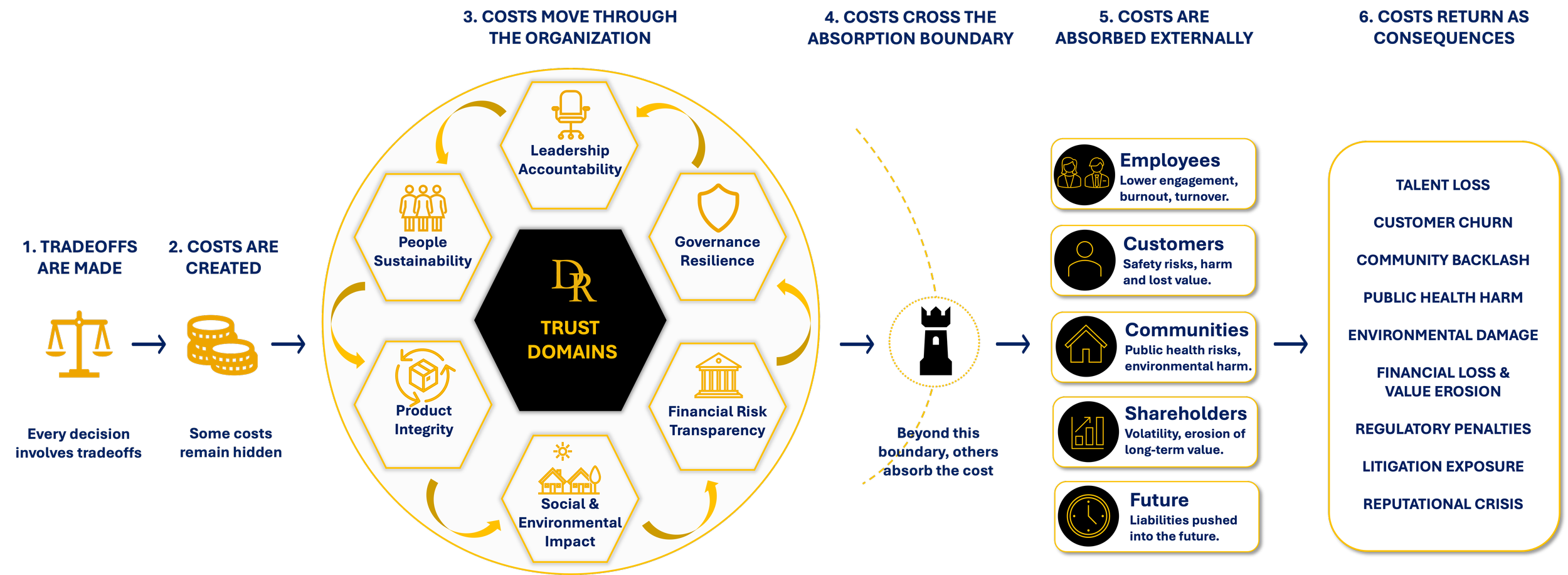
The strength of deserved reputation is revealed by where the consequences of strategic decisions ultimately land— by whether those consequences are absorbed responsibly or shifted onto others.
The Deserved Reputation Framework traces how organizational tradeoffs cause hidden costs — and how those costs move through the organization before they are pushed on stakeholders and later return as external consequences.
The Framework examines six structural domains that determine how costs are created, contained, absorbed, displaced, or allowed to return.
DEFINITION
Leadership Accountability examines whether authority carries consequence. It asks whether the people who make strategic decisions also bear meaningful responsibility when those decisions create harm, strain, or failure.
WHY IT MATTERS
Trust strengthens when leaders absorb responsibility rather than pushing blame downward. When authority remains protected while consequences fall on employees, customers, or lower-level managers, reputation becomes fragile because accountability is asymmetric.
SIX TRUST DOMAINS
DEFINITION
Governance Resilience examines whether rules, oversight, and decision controls can constrain behavior when doing so becomes difficult or costly. It asks whether governance can interrupt momentum, not merely document risk.
WHY IT MATTERS
Strong governance prevents hidden costs from accumulating. It gives the organization the ability to stop, slow, question, or redirect decisions before risk becomes crisis. Weak governance creates the illusion of control while allowing costs to move forward, outward, or downward.
DEFINITION
Product Integrity examines how internal decisions affect customers through the safety, quality, reliability, fairness, and performance of products and services. It asks whether customer trust is protected when pressure increases.
WHY IT MATTERS
Products and services are where organizational choices meet external reality. When companies preserve safety margins, quality standards, and responsible delivery, customer trust is supported. When speed, margin, or growth narrows those safeguards, customers may absorb the cost through harm, defects, confusion, or broken promises.

DEFINITION
Financial Risk Transparency examines whether uncertainty, downside exposure, and performance assumptions are communicated honestly. It asks whether stakeholders understand the real risk profile before volatility or failure appears.
WHY IT MATTERS
Financial trust depends not only on results, but on candor. When opportunity is described in detail but risk is minimized or abstracted, stakeholders are unprepared for what may follow. Reputation weakens when the gap between prior communication and later reality becomes too large to explain.
DEFINITION
Societal and Environmental Impact examines whether an organization internalizes the broader consequences of its operations — including environmental harm, community burden, supply chain impact, public health effects, and social costs.
WHY IT MATTERS
A company may create value while shifting costs onto communities, ecosystems, workers in the supply chain, or the future. Trust becomes more durable when social and environmental commitments actually constrain decisions. It becomes vulnerable when those commitments remain narrative rather than operational.
DEFINITION
People Sustainability examines whether organizational performance depends on sustainable human effort or on exhaustion, silence, fear, overextension, or ethical compromise. It asks whether employees can raise risks, challenge assumptions, and sustain performance without absorbing hidden human costs.
WHY IT MATTERS
Employees often see reputational risk before external stakeholders. When people are protected, heard, and supported, risk signals travel upward. When employees absorb pressure quietly through burnout, turnover, or suppressed dissent, internal trust starts to deteriorate.

The Cost Absorption Boundary
The cost absorption boundary is the line between the costs an organization takes responsibility for and the costs it pushes outward onto others.
When that boundary is strong, the organization internalizes the consequences of its choices through governance, accountability, safeguards, transparency, investment, and remediation.
When that boundary is weak, costs travel outward. Employees absorb them through burnout or disengagement. Customers absorb them through harm, confusion, or lost value. Communities absorb them through social or environmental damage. Shareholders absorb them through volatility and value erosion. The future absorbs them through deferred liabilities, regulatory exposure, litigation, or crisis.
The strength of deserved reputation depends on how well an organization manages this boundary.

The Core Diagnostic Questions
The Deserved Reputation Framework is built around four questions:
1. What tradeoff was made?
What did the organization prioritize — speed, growth, efficiency, margin, control, scale, short-term performance, etc.?
2. What cost did that tradeoff create?
Did it create internal pressure, external harm, fragility, liability, uncertainty, or risk?
3. Who absorbed the cost?
Was the cost absorbed by the organization, or shifted onto employees, customers, communities, shareholders, or the future?
4. How might the cost return?
Could it return as burnout, churn, public backlash, financial loss, regulatory action, litigation, or reputational crisis?
SEE THE FRAMEWORK IN ACTION
Explore case-based application of the Deserved Reputation Framework to learn how tradeoffs, hidden costs, and external consequences impact real organizations.